Watermelon Sorbet

The inspiration for this recipe came from “The Vegan Scoop,” a dairy-free ice cream cookbook by Wheeler Del Torro.  Eating vegan is always my goal, but I realize that simply because something is vegan doesn’t make it healthy.  In fact many vegan recipes, especially those for desserts, contain so much fat and sugar that you might as well eat the real thing;  if health is your concern there’s not much difference.  So, I just had to tweek this recipe to make it a bit more acceptable.

This is a refreshing summer cooler.  With all the added artificial ingredients found in most frozen treats it’s  nice to find one that contains no added sugar, and has all the healthy lycopene found in watermelon naturally.  (Lycopene is thought to reduce the risk of cancer).  The sweet crisp taste will please both young and old alike, and of course, it’s low in calories.  This one won’t weigh you down on a hot summer day 🙂

Ingredients:

6 – 8 cups diced seedless watermelon

1/4 cup Xylitol crystals

Zest of 1 lime, finely chopped or 1 – 2 tsp lime juice

pinch salt

1/4 tsp. Stevia powder

Method:

Using a food processor, puree watermelon into 4 cups.  In a large saucepan over medium heat, bring 1 cup watermelon puree, Xylitol, and lime to a simmer, stirring until sugar dissolves.  Season with salt.  Pour in remaining 3 cups watermelon puree, then add Stevia — whisk until evenly blended.

Pour entire mixture into a metal cake pan and freeze overnight.

The next day, allow frozen watermelon to thaw at room temperature for 5 – 15 minutes.  Using a knife (if it’s too hard let it thaw a little longer), carefully break up puree into 2-inch pieces.  Transfer to food processor in batches and pulse until smooth.

Store in plastic container in freezer for up to one week.

Yield: App. 1 quart

Raw Dehydrated Nuts and Seeds

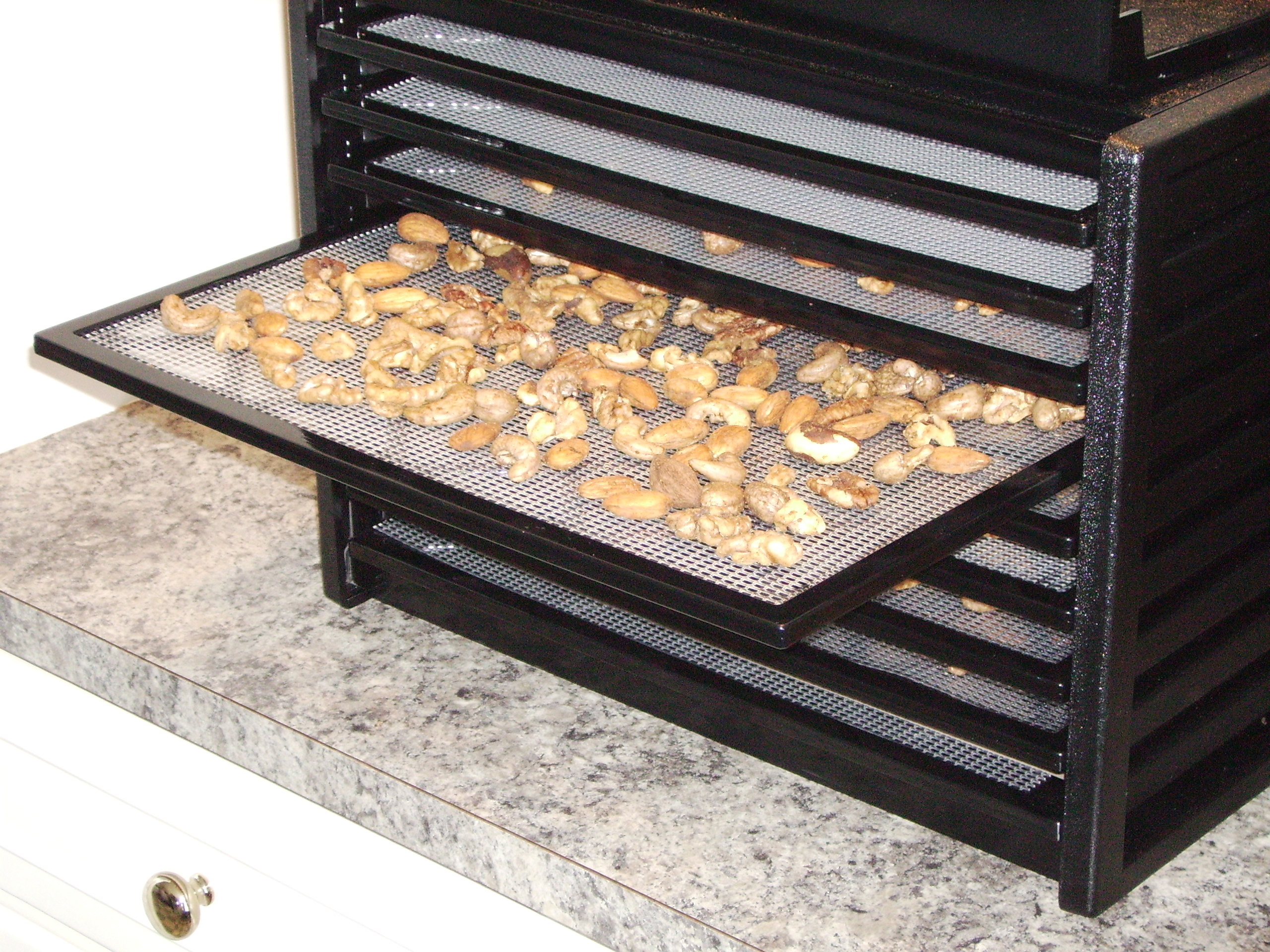
This recipe was graciously shared by Dorothy Gibson, known to many as “the Honey Man’s Wife.”  I regularly shop at their stand, Hallelujah Hive (www.HallelujahHive.com), on Fridays when I’m at Green Dragon Farmer’s Market.  One day she offered a sample of these delicious spiced nuts  after I had told her I was trying to eat a more raw diet.  They are a healthy raw snack that is easy to prepare.  The dehydration process does take a long time, but if you completely fill the dehydrator (mine has 9 shelves) you shouldn’t have to make them too often.  These are so yummy you may be tempted to eat way too many, so please remember that even raw nuts are high in calories — don’t be greedy!

STEP I:

The first step is to soak your choice of mixed nuts and seeds in distilled water for 8 – 12 hours.  This will release the enzyme inhibitors that are present in all nuts and seeds.  As the enzymes are released the nuts become more digestible.  After soaking you can simply refrigerate and use within 2 – 3 days, or you can dehydrate them.

To dehydrate, use a temperature of just 105 degrees for about 36 hours, or until crunchy. It is important to keep the temperature low so enzymes are not destroyed (then you would have cooked food, not raw).  Most ovens are not able to keep a temperature below 118 degrees as is required to prevent enzyme loss.  Enzymes are vital to youth and health for the human body.  If you are using small nuts or seeds like pine nuts or sunflower seeds line the shelves with parchment paper.  You can eat the nuts plain after dehydrating or use one of the versions below:

Dehydrator

STEP II:

Salty Version

For just a salty, non-spicy flavor use Nama Shoyu non-pasturized soy sauce — about 2 Tbsp to every 4 cups nuts and seeds (or about 1 tsp sea salt in 2 Tbsp warm distilled water).  Add Shoyu (or salty water) to nuts in a bowl, stir well and allow to marinate for 2 – 4 hours.  Then, spread the nuts evenly in dehydrator and dehydrate @ 105 degrees for another 36 hours.*

Spicy Version

All the soaking process is the same; the only difference is adding spices to the Nama Shoyu.  For 4 cups nuts/seeds in a small bowl mix the following:

1 Tbsp. onion powder

1 tsp. garlic powder

1 tsp. ground cumin

1/4 tsp. cayenne pepper

Stir until well blended,  add to nuts/seeds and toss until the spices are evenly distributed.  After marinating for two hours, taste to see if you’d like it to be saltier or spicier and adjust if desired; then marinate for two more hours.

STEP III:

Spread the marinated nuts/seeds evenly in the dehydrator and dehydrate @ 105 degrees for approximately 36 hours* or until crunchy.

*Dehydrating is a long process.  Depending on the amount of nuts you are making and the type of dehydrator you have, you may find that you can cut down on the length of time for the second dehydration.  Start checking at around 18 hours, and stop when nuts are dry and crunchy.

NOTE: Dehydrated nuts will keep in your pantry in a well-sealed container for about one month, almost indefinitely in the frig.

Dr. Springer’s Soup

What I love about soup is that it’s never the same. Making soup is such a creative process as you add or subtract ingredients according to what you have on hand. Soup can turn out differently each time you make it and still taste delicious.

This is a humble recipe that my mother made often.  She said she got it from a radio show during the Great Depression when everyone was living off the produce they grew in their home gardens.  (I have no idea who Dr. Springer was.)  When I was growing up this soup was always served with a peanut butter sandwich on the side, and I still think that’s a delicious combination.

This recipe makes a simple, satisfying vegetable soup with minimal ingredients that should be in every kitchen. It is fine as is, or the recipe can be used as a base for a more elaborate soup by using any of the Tips for Making Vegetable Soup.*  I hope you like it.

Ingredients:

1 onion, chopped

1 Tbsp. olive oil

3 – 4 carrots, sliced

3 – 4 stalks celery, sliced

3 – 4 potatoes, peeled and 1 inch cubed

1 qt. stewed tomatoes

Method:

Saute chopped onions in olive oil for about two minutes.

Add all other ingredients and enough water to cover the vegetables by 2 inches.  Bring to a boil then reduce heat to simmer,  and cover.  Cook until vegetables are tender (about 20 minutes).  Season with salt and pepper.


*Tips for Making Vegetable Soup:

_Add some carrot pulp (leftover from juicing) to soup for more fiber.

_Thicken soup easily with instant mashed potato flakes.

_Always add enough water or broth to cover the vegetables by at least 2 inches.

_Some cubed pumpkin or squash may be added along with the vegetables for even more nutrition to tomato-based soups without altering the flavor too much.

_With a submersible stick blender, puree half the soup for dairy-free cream of vegetable soup.

_Another way to make a creamy vegetable soup is to puree a can of rinsed and drained cannellini beans and add it to the broth along with the vegetables.

_Add chopped sea vegetables (kombu or nori) for additional flavor and minerals.

_ Saute onion in a little oil as the first step to add flavor and creaminess.

_Chopped garlic is a flavorful addition to most soups.

_When the soup is done check the seasoning and make appropriate adjustments.

_For more protein 1/2 cup dried lentils or split peas can be added along with the raw vegetables (no presoaking necessary for these small legumes). Red lentils add additional creaminess to the broth.

_Drained and rinsed canned larger beans (kidney, black, navy, pinto, pinto, or lima) can be added along with the vegetables.  Dried beans, however, must be presoaked and cooked before they can be added to a vegetable soup.

_Nutritional yeast will add a hint of cheese flavor and a healthy dose of B12, so important for vegans.

_ 1 tsp. – 1 Tbsp. lemon juice or red wine vinegar will make all the flavors pop 🙂

_Finally, at the end of cooking soup you may add any leftover cooked vegetables, rice, or pasta that have accumulated in your refrigerator over the past few days.  This adds taste and variety and is a thrifty and creative way to use leftovers.

Aladdin Mediterranean Restaurant, 401 Penn Ave. West Reading, PA 19611. Phone 610-685-6677

Aladdin is a wonderful Mideastern restaurant that offers a variety of delectable foods for the health conscious.  They have an extensive vegetarian menu to eat in or take out, and always use the finest fresh ingredients.  It is one of our favorite restaurants in Berks County — we have never been disappointed by the food or the service.  The atmosphere is very ethnic — almost like eating in a desert nomad’s tent or a Mideastern marketplace, complete with music. To add to the fun, Friday night usually features a live bellydancer.

Last night I ordered the Aladdin Makaleh which consisted of grilled cauliflower, zucchini, and eggplant along with falafel topped with shredded lettuce, tomato, onion, and tahini sauce.  It was delicious (and huge)! My husband had the Falafel Salad, which is a very generous serving of falafel, hummus, tabouleh, and tahini sauce.  At only $7.50 it is a bargain.  I have ordered the Falafel Salad in the past and can tell you that their tabouleh is the best!  Don’t let the word “salad” make you think this dish will leave you feeling hungry; it is definitely large enough for a satisfying entrée.  We had fountain drinks (free refills), and did not order dessert because it was a friend’s birthday,  and we had brought our own cake.  Aladdin supplied plates and silverware with a smile.  If you are looking for excellent vegetarian food in Berks County, then you won’t be disappointed with Aladdin.  If you don’t see exactly what you want on the menu, you can make your own combination platter or ask them to alter any item to suit your preference, and they will oblige.

Aladdin is truly a gem — a wonderful compliment to the Main Street revitalization program in West Reading.  Their prices are reasonable and parking is convenient.  Oh, they do serve meat dishes and have a Kids Menu, too 🙂

For more information online:  DineIndie.com/Aladdin

//

“The Ultimate Uncheese Cookbook,” by Jo Stepaniak

“The Ultimate Uncheese Cookbook” is the latest addition to my cookbook library.  Because I was brought up on dairy products there are a few things I really miss eating since becoming a vegetarian; macaroni and cheese is one of them.  I was intrigued by this book because it offers a wide variety of dairy-free recipes from individual un-cheeses to casseroles and desserts.  The secret ingredient in most is nutritional yeast (not active dry yeast; there is a difference).  I couldn’t wait to try them.

The first recipe was the Gooey Grilled Cheez sandwich (page 141).  This recipe, and the others in this cookbook, are uncomplicated and easy to follow.  It was a “high okay” in my opinion.  It had a cheddar-like flavor and was definitely gooey, as melted cheese should be.  As non-cheeses go the flavor was similar to other veggie cheeses — maybe a little less lemon juice would have been better.

The second recipe I tried was the Traditional Macaroni and Cheez (page 112).  This recipe was right on the mark.  It was everything I’d hoped for in a non-dairy recipe and more. The color, texture and flavor were perfect.  I did make one minor alteration to the printed recipe by layering chopped onion between two layers of the macaroni/cheez mixture before baking, because this is the way my family always preferred macaroni and cheese casserole “back in the day.”  Served with stewed tomatoes on top it was just like Grandma used to make — delicious (tastes like pizza)!

Considering all the negatives associated with dairy consumption I am thrilled to have found this cookbook, and I’m looking forward to experimenting with several other recipes in the near future.  Betta Feta (page 45) and Caesar Salad Dressing (page 146) look very intriguing.

I purchased this cookbook on Amazon.com below retail and no shipping charges if your order is over $25.00.  I would definitely recommend “The Ultimate Uncheese Cookbook,” by Jo Stepaniak  if you are serious about following a vegetarian lifestyle.

Steamed Vegetable Casserole

This recipe is only a guideline.  You can use whatever vegetables are cluttering your refrigerator.  I usually make it when I have an overabundance of produce and just need more frig. space.  You can also substitute pasta for the brown rice, and it will be just as delicious.

Ingredients for the sauce:

6 cloves garlic, peeled and pressed

2 Tbsp. soy sauce

2 Tbsp. lemon juice

1/4 tsp. black pepper

Whisk the sauce and put it aside.

Ingredients for casserole:

Whatever vegetables you desire.  Fresh broccoli, carrots, and cauliflower work well.  I’ve also added sweet red peppers, zucchini, green beans, or yellow summer squash to the mix — whatever you have on hand. Cut vegetable into one inch chunks (slice carrot chunks in half), do not chop.

2 cups cooked brown rice or pasta

1 – 2 tsp. Old Bay Seasoning

8 oz. grated veggie cheddar cheese

1 – 2 Tbsp. veggie parmesan cheese

Method:

Using a steamer pot, bring water to a boil over high heat.  Put the veggies in the steamer basket, cover, and cook for about 5 minutes, gently turning the veggies two or three times.  You want them to be crisp-tender, not wilted (the green veggies should be still bright green); if you see them start to wilt or change color remove the pot from the heat — they are done.

In the bottom of a PAM sprayed oblong glass casserole dish, place the cooked brown rice (or pasta).  Sprinkle half the veggie cheddar cheese over rice.  Spread the steamed vegetables over that and sprinkle reserved sauce over the veggies.   Dust with Old Bay Seasoning, to taste.   Top with remaining cheddar cheese and veggie parmesan cheese.

Cover loosely with aluminum foil, and put in 350 degree oven for just 10 minutes (to melt the cheese).

Beautiful colors — healthy and delicious!


Vegan “Parmesan Cheese”

This is an exciting recipe I discovered while viewing a recent cooking demo on http://www.therenegadehealthshow.com . (I highly recommend this site.)

We all know how expensive commercial brands of veggie cheese are, so I couldn’t wait to try this recipe.  I made it last night to serve on tofu stuffed shells, and it was great.  You can make a larger batch to keep on hand. It’s simple and stores well in the refrigerator.

Ingredients:

5 large Brazil nuts, rough chopped

1 Tbsp. nutritional yeast

sea salt to taste (I found that 1/2 tsp. works well)

Grind the nuts.  Add sea salt and nutritional yeast, and grind again.  Done!

Is that easy, or what?

Potato Chips

This recipe is from the cookbook, “How We All Went Raw, Raw Food Recipe Book,” by Charles Nungesser, Coralanne Nungesser, and George Nungesser.  I recently decided to eat more raw and purchased an Excalibur food dehydrator and this book to start on my journey.  This potato chip recipe is the first I tried with my new dehydrator.  I was delighted with the results, and so was my family.  The chips were crispy and delicious.  The only thing I would change is the cayenne pepper.  For my taste 1 tsp. is just too much — way too spicy for me.  Next time I will use 1/4 tsp. cayenne pepper, and I think that would be perfect.

I love that these chips are raw, and that I have the power to regulate the amount of spices;  definitely healthier than the supermarket variety.  A dehydrator uses low temperatures over a longer time than baking does, but don’t worry, it only costs 3 – 6 cents per hour to run a dehydrator, and you will be preserving  the living enzymes in your food.

time: 20 minutes prep

2 – 3 hours to soak

11 – 12 hours to dehydrate

In a bowl, add: 6 red potatoes, thinly sliced (if you use russet potatoes, trim off any green spots)

5 cups distilled water

Soak about 2 – 3 hours; rinse and drain to remove starch.

In a bowl, add:

potato slices

1/4 c. extra virgin olive oil

1/4 c. Ume Plum Vinegar (or raw apple cider vinegar)

1 tsp. cayenne pepper (I think 1/4 tsp. is plenty)

1 – 2 tsp. sea salt, or to taste

Marinate for 1 hour.  Place each chip on a teflex sheet and dehydrate 11 – 12 hours at 105 degrees.


Zucchini “Applesauce”*

The inspiration for this recipe came from http://www.allrecipes.com where you can find several variations of zucchini “applesauce.” I wasn’t quite satisfied with the one I tried, so I added some spices and a few real apples for texture.  (I just didn’t think the texture was authentic without the apples).  I also think you could use stevia as a sweetener if you wanted to avoid the sugar.  (1/2 tsp. stevia equals 1 cup sugar, so add gradually and adjust according to your taste).  This recipe is a surprising way to use up those last few zucchini now that apple season is upon us.

IMG_0219

Ingredients:

2 large zucchini, peeled and chopped.  (If the seeds are large and starting to get hard discard them and use only the fleshy parts)

3 lg. peeled apples (I used Granny Smith), cut into chunks

1/3  c. apple cider vinegar

1 – 2 tsp. cinnamon

1/2 c. sugar

3 Tbsp. brown sugar

1/4 tsp. nutmeg

1/4 tsp. cloves

1/4 tsp. allspice

Method:

Put all ingredients into a large pot. There is no need to add water because there is a lot of water in the zucchini already.  Heat to boiling, and then reduce heat to simmer.  Cover and cook for 30 – 60 minutes, stirring occasionally.  (Cooking time depends on the zucchini.)

When the mixture has cooled then you want to blend it until mushy like applesauce.  I used a Foley Mill to do this (the old fashioned way).  You could also puree the cooled mixture in a blender or food processor.

*One of our favorite ways to eat any kind of applesauce is to pair it with a peanut butter sandwich for a very kid-friendly lunch 🙂

Freeze Your Tomato Harvest

IMG_0166

I grew up helping my mother can tomatoes the old fashioned way. We spent hours skinning the tomatoes in boiling water, sterilizing glass quart jars, and then processing the tomato-filled jars in a boiling water bath and waiting to hear the “pop” as each jar cooled and sealed. It was an all day project that most gardeners endured in order to enjoy the fruit of their labor during the long winter months.

Later, as a young wife, my mother-in-law taught me how to freeze fresh tomatoes. It still involved skinning the tomatoes in boiling water, and then slicing them into eighths. But, instead of the canning process, you just had to pack and freeze them in plastic quart containers. I thought this system was a real time saver, and did it that way for years.

Imagine my surprise when I learned just last year that there is a MUCH simpler way to freeze all the tomatoes we harvest from our garden, and now this is how I do it:

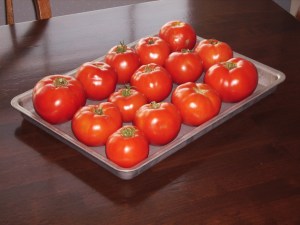
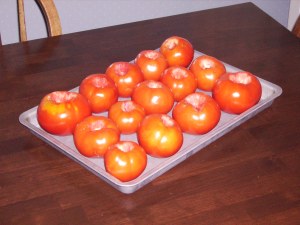
First, wash and core (cut out the stem end) your whole tomatoes.

Place the cored tomatoes on a tray with sides (leave a little space around each one — you don’t want them to touch) and place the tray in the freezer. (notice that you DO NOT have to peel the tomatoes). IMG_0177

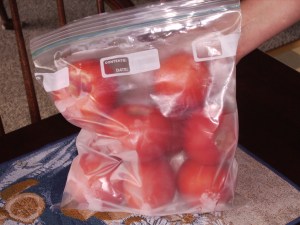
When they are completely frozen (like the next day), put the whole frozen tomatoes in a gallon size plastic freezer bag, zip closed, and store in the freezer until needed.

When you are ready to use, simply remove however many tomatoes you need and hold each one under hot running water. The skin will easily slip off the frozen tomato. Then let them defrost just long enough to be able to slice or chop.

That’s it! You can easily fit this method of preserving your tomato harvest into even the busiest day and be satisfied with the results.

IMG_0183